PETG (General Purpose)
Tough & Chemical Resistant
The All-Rounder
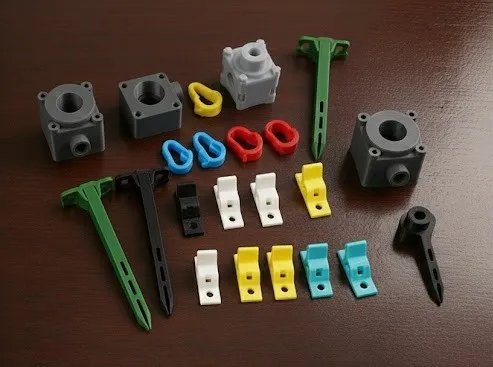
PETG is the "workhorse" of functional 3D printing. It combines the ease of printing of PLA with the durability of ABS. It is naturally UV-resistant (great for outdoors), chemically resistant to acids/cleaners, and has a higher temperature resistance (~70°C) than PLA. However, it is slightly softer, meaning it will flex more than PLA before breaking.
Best For: Outdoor brackets, garden tools, drone parts, and chemical containers.
Best For: Outdoor brackets, garden tools, drone parts, and chemical containers.
| Tensile Strength | ~50 MPa ★★★★☆ (Strong) |
| Tensile Stiffness | ~2.1 GPa ★★★☆☆ (Semi-Flex) |
| Impact Resistance | High ★★★★★ (Durable) |
| Shear Resistance | ~50 MPa ★★★★★ (Best Bond) |
| Chemical Resistance | High ★★★★☆ (Acids/Salts) |
| Heat Resistance | ~70 °C ★★★☆☆ (Outdoor) |
PETG CF
Carbon-Fiber Reinforced
Max Stiffness
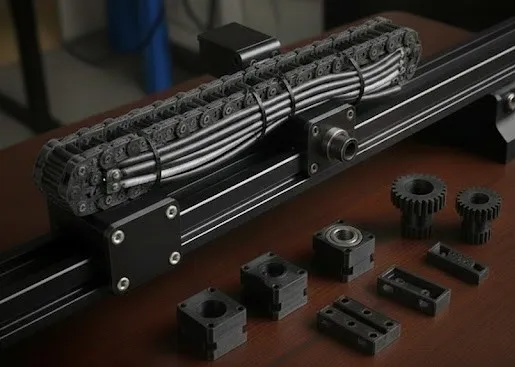
By adding carbon fibers to the PETG matrix, we eliminate the material's natural flexibility. This results in a part that is incredibly stiff, dimensionally stable, and resistant to heat (~80°C). The fibers also provide a textured matte finish that hides layer lines. It retains PETG's chemical resistance but is much more rigid.
Best For: Structural brackets, mechanical gears, and stiff outdoor parts.
Best For: Structural brackets, mechanical gears, and stiff outdoor parts.
| Tensile Strength | 60+ MPa ★★★★★ (Very Strong) |
| Tensile Stiffness | ~4.0 GPa ★★★★★ (Rigid) |
| Impact Resistance | Moderate ★★★☆☆ (Tough) |
| Shear Resistance | ~50 MPa ★★★★☆ (Strong Bond) |
| Chemical Resistance | High ★★★★★ (Resistant) |
| Heat Resistance | ~80 °C ★★★★☆ (Stable) |
AHT (High Temp)
Annealable High-Temperature System
Heat Resistant
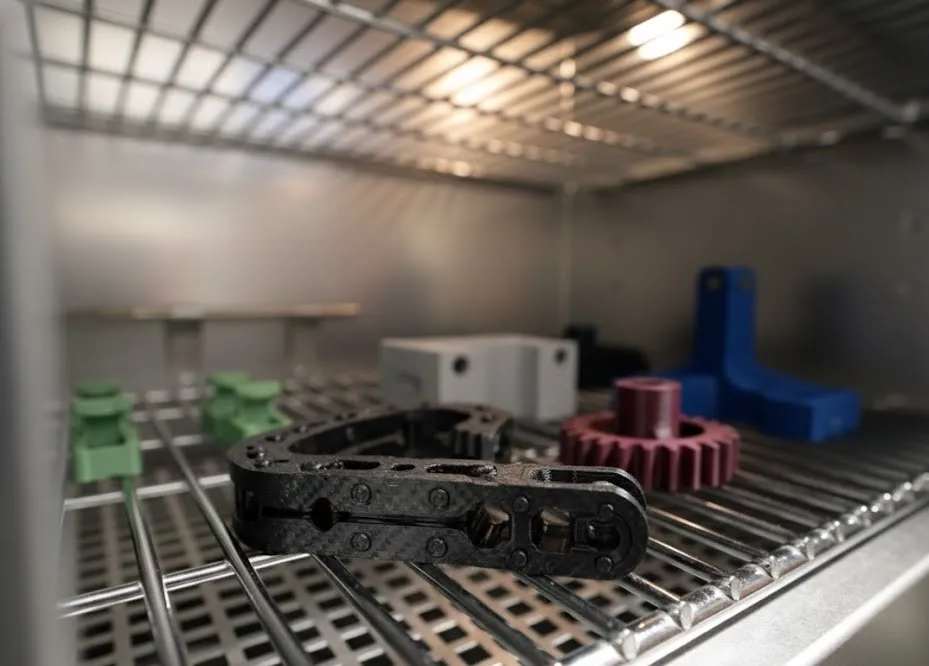
AHT is a specialized PETG-based polymer designed for extreme thermal environments. When printed, it behaves like standard PETG. However, after a secondary "Annealing" (baking) process, its crystalline structure changes, boosting its heat resistance up to 95°C+ and significantly increasing its strength.
Best For: Automotive engine components, hot-air ducts, and industrial machinery covers.
Best For: Automotive engine components, hot-air ducts, and industrial machinery covers.
| Tensile Strength | 55–60 MPa ★★★★☆ (Strong) |
| Tensile Stiffness | ~2.4 GPa ★★★☆☆ (Standard) |
| Impact Resistance | Moderate ★★★☆☆ (Good) |
| Shear Resistance | ~40 MPa ★★★☆☆ (Moderate) |
| Chemical Resistance | High ★★★★☆ (Resistant) |
| Heat Resistance | ~95 °C+ ★★★★★ (Annealed*) |
Custom Prototyping
Your Design, Our Engineering
Print on Demand

Don't see what you need? We can make it.
We offer bespoke engineering and manufacturing services. Whether you have a CAD file ready to print or just an idea on a napkin, our engineers can bring it to life. From one-off prototypes to small-batch production runs.
Services: CAD Design, Reverse Engineering, Batch Production.
We offer bespoke engineering and manufacturing services. Whether you have a CAD file ready to print or just an idea on a napkin, our engineers can bring it to life. From one-off prototypes to small-batch production runs.
Services: CAD Design, Reverse Engineering, Batch Production.
| Max Build Vol | 256 x 256 x 256 mm (Large Scale) |
| Accuracy | ± 0.1 mm (Precision) |
| Lead Time | 4–10 Days (Standard Turnaround) |
| File Types | STL, OBJ, STEP (CAD Ready) |
| Min Order | 1 Unit (No Minimum) |
| Design Service | Available (Hourly Rate) |
Frequently Asked Questions about PETG
Is PETG better than PLA for outdoor use?
Yes, definitely. PETG is naturally UV-resistant and does not degrade in water or sunlight like PLA does. It is the perfect choice for garden tools, drone parts, or outdoor brackets.
Is PETG Food Safe?
The raw material (PETG) is the same plastic used in water bottles and is inherently food-safe. However, 3D printed parts have micro-layers where bacteria can hide. For food contact, we recommend sealing the part with a food-safe epoxy.
When should I use PETG instead of PLA?
Choose **PETG** if your part needs to flex without snapping (like a clip), survive in a hot car, or stay outdoors. Choose **PLA** if you need the best possible visual detail and do not need high heat resistance.